
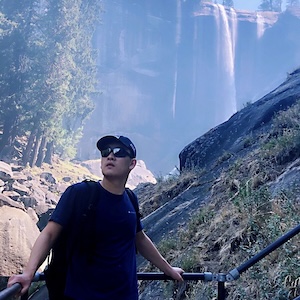
I am a second year PhD student advised by Professor Kostas Bekris. I received my masters from Columbia University where I worked with Professor Matei Ciocarlie. I received my bachelors from Rutgers University as an Honors College Student.
My research is on control and planning for tensegrity, a type of soft-rigid hybrid structure, robots using both classical and learning (such as Deep Reinforcement Learning) methods.
Publications:
2026 |
Chen, N; Meng, P; Tang, C; Degay, A; Brei, Z; Kramer-Bottiglio, R; Bekris, K; Aanjaneya, M Model Predictive Control of Tensegrity Robots via Contact-Aware Graph Neural Dynamics Model Inproceedings IEEE/RSJ International Conference on Intelligent Robots and Systems (IROS), 2026. @inproceedings{mpc_gnn_iros26, title = {Model Predictive Control of Tensegrity Robots via Contact-Aware Graph Neural Dynamics Model }, author = {N Chen and P Meng and C Tang and A Degay and Z Brei and R Kramer-Bottiglio and K Bekris and M Aanjaneya}, year = {2026}, date = {2026-09-28}, booktitle = {IEEE/RSJ International Conference on Intelligent Robots and Systems (IROS)}, abstract = {Tensegrity robots offer lightweight, compliant mobility over challenging terrain but remain difficult to model and control due to complex contact-rich dynamics and partial observability. This work presents a model predictive path integral (MPPI) controller for a three-bar tensegrity robot driven by a learned graph neural network (GNN) dynamics model. This work first extends prior GNN-based models with a differentiable contact detection module. The extension allows the dynamics model to reason over non-horizontal planar terrains, obstacles, as well as self-collisions. Then, the learned dynamics model and the MPPI controller operate in a closed data-collection loop, iteratively improving model accuracy and control performance. This work further introduces a hybrid MPPI strategy that combines MPPI with turning motion primitives to improve maneuverability. Experiments are performed in MuJoCo across five navigation tasks, which include, wall obstacles, inclines, narrow corridors, low-clearance structures, and a composite 3D obstacle course. The experiments demonstrate that the hybrid MPPI controller operating over the learned GNN dynamics model improves predictive accuracy over a flat-ground baseline model and achieves superior navigation performance compared to A∗-based re-planning and MPPI-only variants. Results show that the contact-aware learned dynamics combined with the sampling-based model predictive control enable robust tensegrity navigation in complex, contact-rich environments.}, keywords = {}, pubstate = {published}, tppubtype = {inproceedings} } Tensegrity robots offer lightweight, compliant mobility over challenging terrain but remain difficult to model and control due to complex contact-rich dynamics and partial observability. This work presents a model predictive path integral (MPPI) controller for a three-bar tensegrity robot driven by a learned graph neural network (GNN) dynamics model. This work first extends prior GNN-based models with a differentiable contact detection module. The extension allows the dynamics model to reason over non-horizontal planar terrains, obstacles, as well as self-collisions. Then, the learned dynamics model and the MPPI controller operate in a closed data-collection loop, iteratively improving model accuracy and control performance. This work further introduces a hybrid MPPI strategy that combines MPPI with turning motion primitives to improve maneuverability. Experiments are performed in MuJoCo across five navigation tasks, which include, wall obstacles, inclines, narrow corridors, low-clearance structures, and a composite 3D obstacle course. The experiments demonstrate that the hybrid MPPI controller operating over the learned GNN dynamics model improves predictive accuracy over a flat-ground baseline model and achieves superior navigation performance compared to A∗-based re-planning and MPPI-only variants. Results show that the contact-aware learned dynamics combined with the sampling-based model predictive control enable robust tensegrity navigation in complex, contact-rich environments. |
Granados, E; Meng, P; Tang, C; Sangani, S; Johnson, W; Kramer-Bottiglio, R; Bekris, K State and Trajectory Estimation of Tensegrity Robots via Factor Graphs and Chebyshev Polynomials Inproceedings 9th IEEE-RAS International Conference on Soft Robotics (RoboSoft), Kanazawa, Japan, 2026. @inproceedings{granados_factor_graph_tensegrity, title = {State and Trajectory Estimation of Tensegrity Robots via Factor Graphs and Chebyshev Polynomials}, author = {E Granados and P Meng and C Tang and S Sangani and W Johnson and R Kramer-Bottiglio and K Bekris}, year = {2026}, date = {2026-04-08}, booktitle = {9th IEEE-RAS International Conference on Soft Robotics (RoboSoft)}, address = {Kanazawa, Japan}, abstract = {Tensegrity robots offer compliance and adaptability, but their nonlinear, and underconstrained dynamics make state estimation challenging. Reliable continuous-time estimation of all rigid links is crucial for closed-loop control, system identification, and machine learning; however, conventional methods often fall short. This paper proposes a two-stage approach for robust state or trajectory estimation (i.e., filtering or smoothing) of a cable-driven tensegrity robot. For online state estimation, this work introduces a factor-graph-based method, which fuses measurements from an RGB-D camera with on-board cable length sensors. To the best of the authors’ knowledge, this is the first application of factor graphs in this domain. Factor graphs are a natural choice, as they exploit the robot’s structural properties and provide effective sensor fusion solutions capable of handling nonlinearities in practice. Both the Mahalanobis distance-based clustering algorithm, used to handle noise, and the Chebyshev polynomial method, used to estimate the most probable velocities and intermediate states, are shown to perform well on simulated and real-world data, compared to an ICP-based algorithm. Results show that the approach provides high fidelity, continuous-time state and trajectory estimates for complex tensegrity robot motions.}, keywords = {}, pubstate = {published}, tppubtype = {inproceedings} } Tensegrity robots offer compliance and adaptability, but their nonlinear, and underconstrained dynamics make state estimation challenging. Reliable continuous-time estimation of all rigid links is crucial for closed-loop control, system identification, and machine learning; however, conventional methods often fall short. This paper proposes a two-stage approach for robust state or trajectory estimation (i.e., filtering or smoothing) of a cable-driven tensegrity robot. For online state estimation, this work introduces a factor-graph-based method, which fuses measurements from an RGB-D camera with on-board cable length sensors. To the best of the authors’ knowledge, this is the first application of factor graphs in this domain. Factor graphs are a natural choice, as they exploit the robot’s structural properties and provide effective sensor fusion solutions capable of handling nonlinearities in practice. Both the Mahalanobis distance-based clustering algorithm, used to handle noise, and the Chebyshev polynomial method, used to estimate the most probable velocities and intermediate states, are shown to perform well on simulated and real-world data, compared to an ICP-based algorithm. Results show that the approach provides high fidelity, continuous-time state and trajectory estimates for complex tensegrity robot motions. |
Johnson, W; Meng, P; Chen, N; Cimatti, L; Vercoutere, A; Aanjaneya, M; Kramer-Bottiglio, R; Bekris, K An Open-Source, Reproducible Tensegrity Robot that can Navigate Among Obstacles Journal Article IEEE Robotics and Automation Letters (RA-L) [Also appearing at the IEEE/RSJ IROS conference], 2026. @article{open_source_tensegrity, title = {An Open-Source, Reproducible Tensegrity Robot that can Navigate Among Obstacles}, author = {W Johnson and P Meng and N Chen and L Cimatti and A Vercoutere and M Aanjaneya and R Kramer-Bottiglio and K Bekris }, url = {https://ieeexplore.ieee.org/document/11474858}, year = {2026}, date = {2026-02-05}, journal = {IEEE Robotics and Automation Letters (RA-L) [Also appearing at the IEEE/RSJ IROS conference]}, abstract = {Tensegrity robots, composed of rigid struts and elastic tendons, provide impact resistance, low mass, and adaptability to unstructured terrain. Their compliance and complex, coupled dynamics, however, present modeling and control challenges, hindering planning and obstacle avoidance. This paper presents a complete, open-source, and reproducible system that enables navigation for a 3-bar tensegrity robot. The system comprises: (i) an inexpensive, open-source hardware design, and (ii) an integrated, open-source software stack for physics-based modeling, system identification, state estimation, path planning, and control. All hardware and software are publicly available at https://sites.google.com/view/tensegrity-navigation/. The proposed system tracks the robot using a static overhead camera and executes collision-free paths to a goal among known obstacle locations. System robustness is demonstrated through experiments involving unmodeled environmental challenges, including a vertical drop, an incline, and granular media, culminating in an outdoor field demonstration. To validate reproducibility, experiments were conducted using robot instances at two different laboratories. This work provides the robotics community with a complete navigation system for a compliant, impact-resistant, and shape-morphing robot. This system is intended to serve as a springboard for advancing the navigation capabilities of other unconventional robotic platforms.}, keywords = {}, pubstate = {published}, tppubtype = {article} } Tensegrity robots, composed of rigid struts and elastic tendons, provide impact resistance, low mass, and adaptability to unstructured terrain. Their compliance and complex, coupled dynamics, however, present modeling and control challenges, hindering planning and obstacle avoidance. This paper presents a complete, open-source, and reproducible system that enables navigation for a 3-bar tensegrity robot. The system comprises: (i) an inexpensive, open-source hardware design, and (ii) an integrated, open-source software stack for physics-based modeling, system identification, state estimation, path planning, and control. All hardware and software are publicly available at https://sites.google.com/view/tensegrity-navigation/. The proposed system tracks the robot using a static overhead camera and executes collision-free paths to a goal among known obstacle locations. System robustness is demonstrated through experiments involving unmodeled environmental challenges, including a vertical drop, an incline, and granular media, culminating in an outdoor field demonstration. To validate reproducibility, experiments were conducted using robot instances at two different laboratories. This work provides the robotics community with a complete navigation system for a compliant, impact-resistant, and shape-morphing robot. This system is intended to serve as a springboard for advancing the navigation capabilities of other unconventional robotic platforms. |
2024 |
Bekris, K; Doerr, J; Meng, P; Tangirala, S The State of Robot Motion Generation Inproceedings International Symposium of Robotics Research (ISRR), Long Beach, California, 2024. @inproceedings{Bekris:2024aa, title = {The State of Robot Motion Generation}, author = {K Bekris and J Doerr and P Meng and S Tangirala}, url = {https://arxiv.org/abs/2410.12172}, year = {2024}, date = {2024-12-01}, booktitle = {International Symposium of Robotics Research (ISRR)}, address = {Long Beach, California}, abstract = {This paper first reviews the large spectrum of methods for generating robot motion proposed over the 50 years of robotics research culminating to recent developments. It crosses the boundaries of methodologies, which are typically not surveyed together, from those that operate over explicit models to those that learn implicit ones. The paper concludes with a discussion of the current state-of-the-art and the properties of the varying methodologies highlighting opportunities for integration.}, keywords = {}, pubstate = {published}, tppubtype = {inproceedings} } This paper first reviews the large spectrum of methods for generating robot motion proposed over the 50 years of robotics research culminating to recent developments. It crosses the boundaries of methodologies, which are typically not surveyed together, from those that operate over explicit models to those that learn implicit ones. The paper concludes with a discussion of the current state-of-the-art and the properties of the varying methodologies highlighting opportunities for integration. |
2021 |
Meng, P; Wang, W; Balkcom, D; Bekris, K ASCE Earth and Space Conference 2021, Seattle, WA, 2021. @conference{Meng:2021aa, title = {Proof-Of-Concept Designs for the Assembly of Modular, Dynamic Tensegrities into Easily Deployable Structures}, author = {P Meng and W Wang and D Balkcom and K Bekris}, url = {https://par.nsf.gov/servlets/purl/10294210}, year = {2021}, date = {2021-10-01}, booktitle = {ASCE Earth and Space Conference 2021}, address = {Seattle, WA}, abstract = {Dynamic tensegrity robots are inspired by tensegrity structures in architecture; arrangements of rigid rods and flexible elements allow the robots to deform. This work proposes the use of multiple, modular, tensegrity robots that can move and compliantly connect to assemble larger, compliant, lightweight, strong structures and scaffolding. The focus is on proof-of-concept designs for the modular robots themselves and their docking mechanisms, which can allow the easy deployment of structures in unstructured environments. These mechanisms include (electro)magnets to allow each individual robot to connect and disconnect on cue. An exciting direction is the design of specific module and structure designs to fit the mission at hand. For example, this work highlights how the considered three bar structures could stack to form a column or deform on one side to create an arch. A critical component of future work will involve the development of algorithms for automatic design and layout of modules in structures.}, keywords = {}, pubstate = {published}, tppubtype = {conference} } Dynamic tensegrity robots are inspired by tensegrity structures in architecture; arrangements of rigid rods and flexible elements allow the robots to deform. This work proposes the use of multiple, modular, tensegrity robots that can move and compliantly connect to assemble larger, compliant, lightweight, strong structures and scaffolding. The focus is on proof-of-concept designs for the modular robots themselves and their docking mechanisms, which can allow the easy deployment of structures in unstructured environments. These mechanisms include (electro)magnets to allow each individual robot to connect and disconnect on cue. An exciting direction is the design of specific module and structure designs to fit the mission at hand. For example, this work highlights how the considered three bar structures could stack to form a column or deform on one side to create an arch. A critical component of future work will involve the development of algorithms for automatic design and layout of modules in structures. |